Supermicro motherboard loud third-party fans fix

Supermicro motherboard loud third-party fans fix

When installing third-party PWM fans, like from Noctua, into a supermicro motherboard, you will probably get loud fans or fans that are spinning up and down. Fan control options in the BIOS and the IPMI interface is very basic and switching between the fan modes might still not fix the issue.
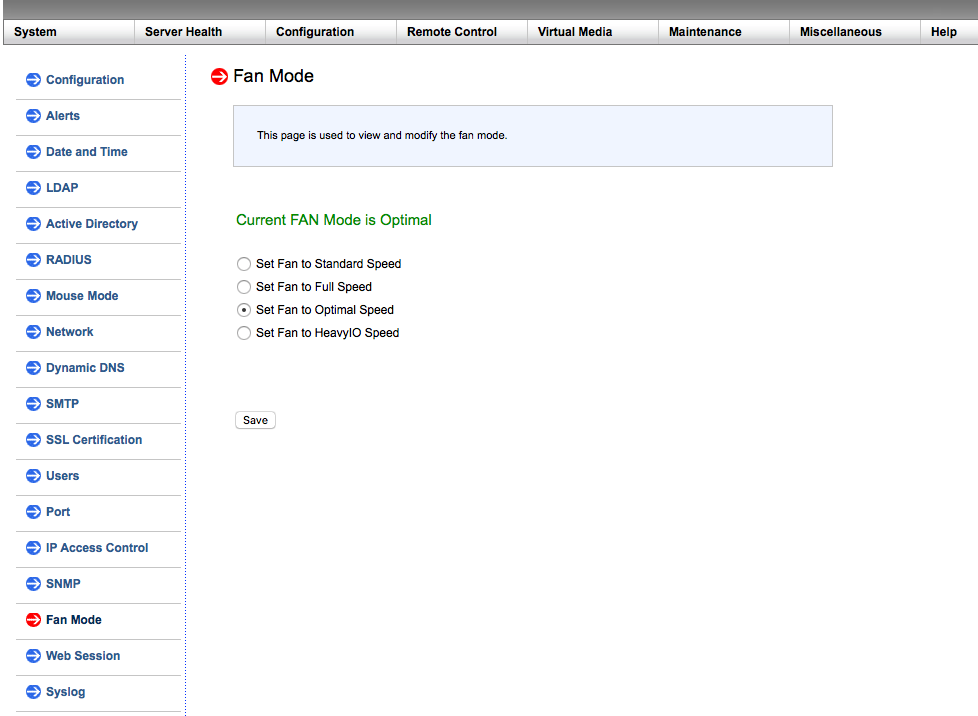


Figure 1: Fan modes in a typical Supermicro IPMI GUI

The Reason

Third-party fans have a lower minimum rotation speed than the OEM fans from Supermicro. For example, Noctua NF-A12x25 fans can ramp down to 450rpm whereas the Supermicro FAN-0077L4 can only come down to ~700rpm.

At Idle, the Supermicro motherboard upon receiving a PWM signal that the third-party fan is running at 450 rpm, which is below the critical value for the OEM fan, assumes the fan is broken and sends a 100% fan signal. which causes the fan to ramp up and then down again in a loop.

The Fix

Boot to a live ubuntu environment and install ipmitool:

sudo apt update && sudo apt install ipmitool

change the PWM header's critical rpm values:

sudo ipmitool sensor thresh FAN1 lower 150 225 300

FAN1 – FAN header for which you want to set the values
150 – lower non-recoverable value
225 – lower critical value
300 – lower non-critical value

Repeat the last command for FAN2, FAN3.. corresponding to the number of PWM headers on the motherboard.

After you run the command for all fan headers on your Supermicro motherboard – shutdown and disconnect the power cord and leave it off for few minutes. After you power it on again, the fans should work normally.

Applying the Fix remotely over the network

Change the command to include the IPMI interface address as below:

sudo ipmitool -I lan -U ADMIN -H 10.100.10.200 sensor thresh FAN1 lower 150 225 300

You will be asked for IPMI password after this entering command.


    • Related Articles

    • How to apply RMA on Supermicro Portal.

      The following information we need to collect from the customer before applying for RMA on Supermicro portal. 1: Fully filled Mbuzz RMA Form. 2: Correct P/N(Server),S/N(Server), Invoice Copy, complete description of an error, troubleshooting steps ...
    • Supermicro - Frequently Asked Questions

      1. Is it possible to get a list of all EOL models in the Supermicro Website? Or is there any list that you can share on a periodic basis? Ans. Supermicro don’t have such list available to share. They can provide the information on a case-to-case ...
    • What does the Supermicro 'BEEP' codes mean and what does the flashing 'LEDs' indicate?

      Why does Servers / Computers output beep codes or flash LEDs? All computers (Servers, workstations, laptops, AIOs, etc.) goes through a process called POST (Power-on Self-Test) checks when powered on. This is the process of the computer to check its ...
    • Personal Computers and Servers - Classification and Point of Contact

      We can classify the computers that MBUZZ handles based on their form-factor as below: Tower Workstations, Desktops, Gaming PCs and SFF (Small form factor) PCs fall under this category. These are computers people would use on a desk and rarely move. ...
    • How to register online case with Supermicro

      Use the following link to go on the support platform of Supermicro. https://webpr3.supermicro.com/SupportPortal/Default 1: Create an account try to use your office mail ID as we will get all the case info on registered mail ID. 2: Add all details and ...
    • Popular Articles

    • CP Plus Camera and NVR Configuration

      NVR Configuration The CP Plus Pro Series of NVRs have been meticulously designed for providing you with upgraded performance and higher recording quality in your IP video surveillance solution. The robust processor that has been inculcated in this ...
    • Kerberos Authentication – Overview

      What is Kerberos? Kerberos is a secure authentication method used in our Active Directory (AD) environment (mbuzztech.com). It allows users to: Access multiple systems without re-entering passwords (Single Sign-On – SSO) Log in once Where We Use It ...
    • How to Remove and Reinstall NVIDIA Drivers on Ubuntu

      This article provides step by step guide to completely remove existing NVIDIA drivers and reinstall specific version of the NVIDIA driver on the Ubuntu system Prerequisites Administrative (sudo) access to the Ubuntu system. Internet access to ...
    • Personal Computers and Servers - Classification and Point of Contact

      We can classify the computers that MBUZZ handles based on their form-factor as below: Tower Workstations, Desktops, Gaming PCs and SFF (Small form factor) PCs fall under this category. These are computers people would use on a desk and rarely move. ...
    • M.2 SSD Tier List

      The sequential read and write speeds, which are usually the most advertised number, are not a proper benchmark of real-world performance or the quality of an SSD. This article categorizes and tiers SSDs based on factors like the type of NAND flash, ...