KB 591186 - Creating a multi-OS live USB with Ventoy
Instead of having separate USBs for Windows, Linux and their variants,
Ventoy allows you to assign a single drive capable of booting to any OS you choose. After setup, you can drag-and-drop iso files into the external drive and it will show up as an option in Ventoy.
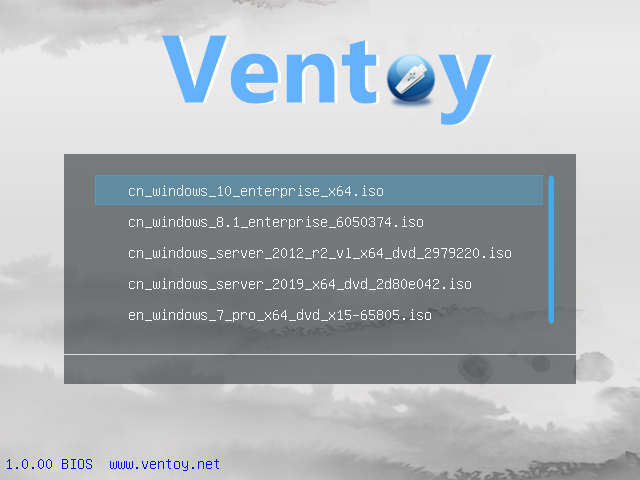
With Ventoy, you don't need tools like rufus or etcher to make an iso bootable. Since it shows up as a normal external drive when you plug it into a PC you can use it as more than just a boot drive.

You will need administrator or super-user privileges to set up Ventoy
Download the latest windows zip installation package, like ventoy-x.x.xx-windows.zip, and decompress it.
Run Ventoy2Disk.exe, select the device and click Install or Update button

if Ventoy2Disk.exe always fail, you can use Ventoy LiveCD, See:
livecd . VentoyVentoy can be installed on USB drive or local disk. To prevent misoperation, Ventoy2Disk.exe only lists USB drives by default.
You can toggle the Show all devices option then all the disks will be listed. But at this time, you must be very careful to not choose the wrong disk.
After install, you can manually reformat the Ventoy partition with exFAT/FAT32/NTFS/UDF/XFS/Ext2/3/4
Related Articles
KB 258332 - Backup, Snapshot, and Restore Linux installations using Timeshift
If you mess up (or are going to mess up) some config files or drivers, it is always good to have a fallback point. The de-facto standard for doing this on Linux is Timeshift. Timeshift for Linux is an application that provides functionality similar ...
KB 361001 - What is Boot Process in Linux OS.
Boot Process in Linux OS. Have you ever wondered what happens behind the scenes from the time you press the power button until the Linux login prompt appears? Press the power button on your system, and after few moments you see the Linux login ...
KB 965001 - Installing Drivers and Activating Windows using Audit Mode
Installing Drivers and Activating Windows Through OOBE or Audit Mode It is important to let customers customize their Windows first boot settings (OOBE settings). The entire installation process for a custom build must be carried out manually, for ...
How to Partition, Format, and Mount Secondary Drives in Linux - Manual Drive Configuration (MDC)
Introduction This guide provides detailed instructions on how to manually configure secondary drives in a Linux system, including partitioning, formatting, and mounting the drives. Warning Performing these steps on an existing primary drive or a ...
KB 052001 - "D3D11" GPU Error in Windows 11/10
The D3D11 error, which often leads to display crashes, typically occurs when the GPU driver crashes. This issue can arise during the installation of GPU-related drivers or while using software or applications that heavily utilize the GPU. D3D11 Error ...
Recent Articles
KB-630208 | How to use Find and Locate to search for files in Linux
Purpose To provide Linux administrators and Field Engineers with guidance on using the find and locate utilities to efficiently search for files and directories within a Linux filesystem based on criteria such as name, type, size, timestamps, ...
KB-630164 | How to use rsync to Synchronize Files
Purpose To provide a clear and practical procedure for using the rsync utility to synchronize files and directories between local systems and remote hosts, including push and pull operations, while preserving file attributes and optimizing data ...
KB-630107 | How to create a Linux swap file
Purpose To provide Field Engineers and Linux administrators with a standardized procedure for creating, configuring, and validating a Linux swap file. This procedure helps ensure sufficient virtual memory is available when physical RAM is exhausted ...
MSI All-in-One (AIO) PC – Physical Damage Policy for Warranty Claims
MSI All-in-One (AIO) PC – Physical Damage Policy for Warranty Claims MSI's standard warranty does not cover physical or accidental damage to an All-in-One (AIO) PC. If the damage is determined to be caused by external factors rather than a ...
KB 134833 - Troubleshooting NVSM Alert NV-CPU-XX – Unrecoverable CPU Internal Error
Purpose This document provides a general troubleshooting procedure for the NVIDIA System Management (NVSM) alert NV-CPU-XX, which indicates that a CPU has reported an internal error. The article outlines how to verify whether the alert represents an ...
Popular Articles
CP Plus Camera and NVR Configuration
NVR Configuration The CP Plus Pro Series of NVRs have been meticulously designed for providing you with upgraded performance and higher recording quality in your IP video surveillance solution. The robust processor that has been inculcated in this ...
KB 775235 - Kerberos Authentication – Overview
What is Kerberos? Kerberos is a secure authentication method used in our Active Directory (AD) environment (mbuzztech.com). It allows users to: Access multiple systems without re-entering passwords (Single Sign-On – SSO) Log in once Where We Use It ...
How to Remove and Reinstall NVIDIA Drivers on Ubuntu
This article provides step by step guide to completely remove existing NVIDIA drivers and reinstall specific version of the NVIDIA driver on the Ubuntu system Prerequisites Administrative (sudo) access to the Ubuntu system. Internet access to ...
KB 692001 - Personal Computers and Servers - Classification and Point of Contact
We can classify the computers that MBUZZ handles based on their form-factor as below: Tower Workstations, Desktops, Gaming PCs and SFF (Small form factor) PCs fall under this category. These are computers people would use on a desk and rarely move. ...
KB 298031 - M.2 SSD Tier List
The sequential read and write speeds, which are usually the most advertised number, are not a proper benchmark of real-world performance or the quality of an SSD. This article categorizes and tiers SSDs based on factors like the type of NAND flash, ...